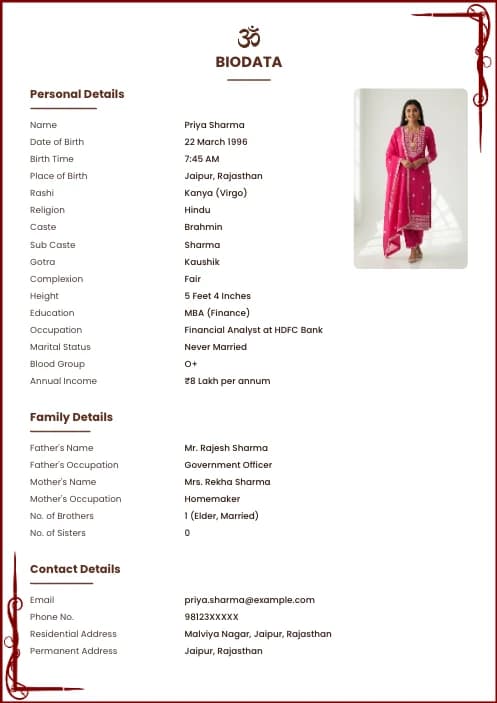
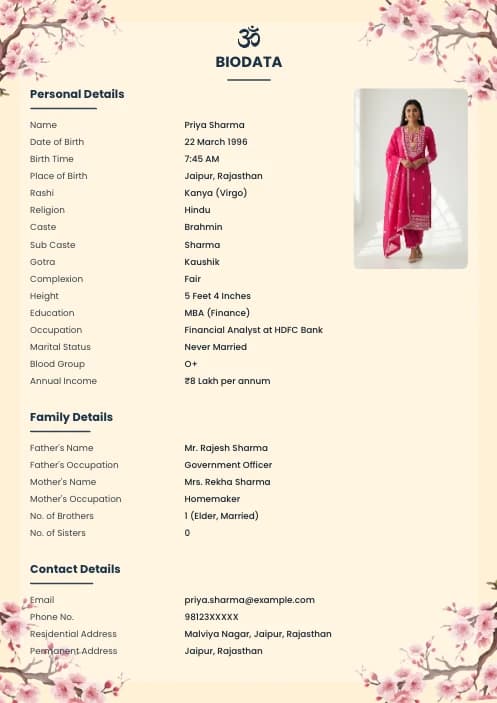
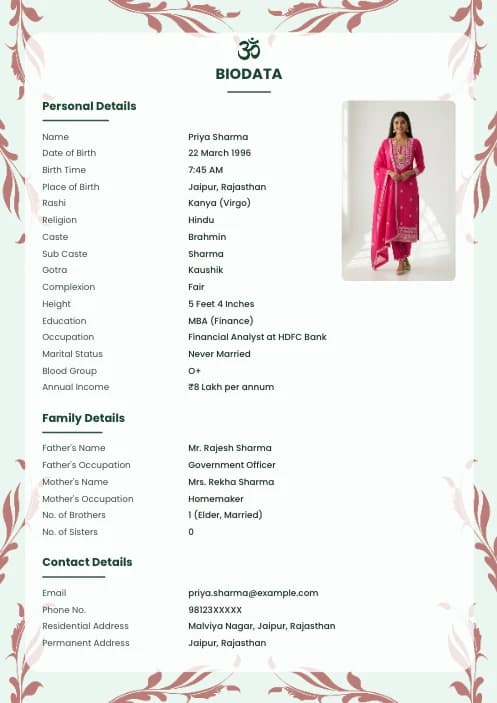
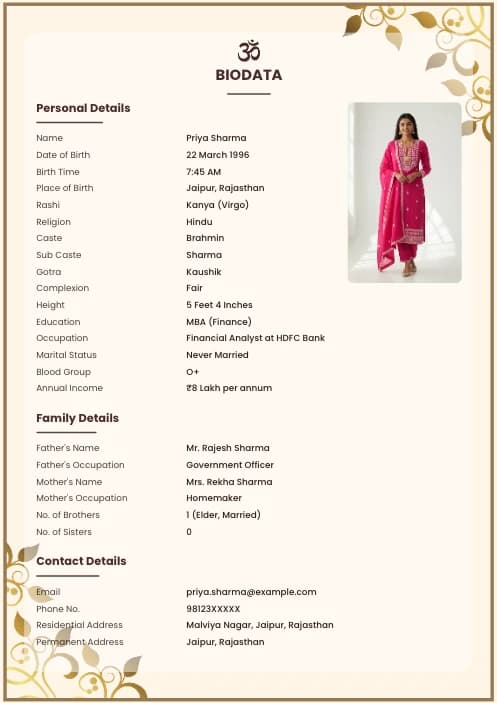
What is a Biodata Format?
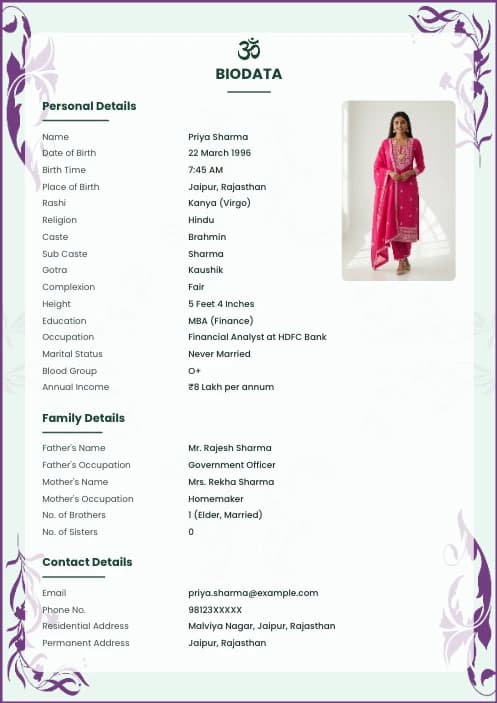
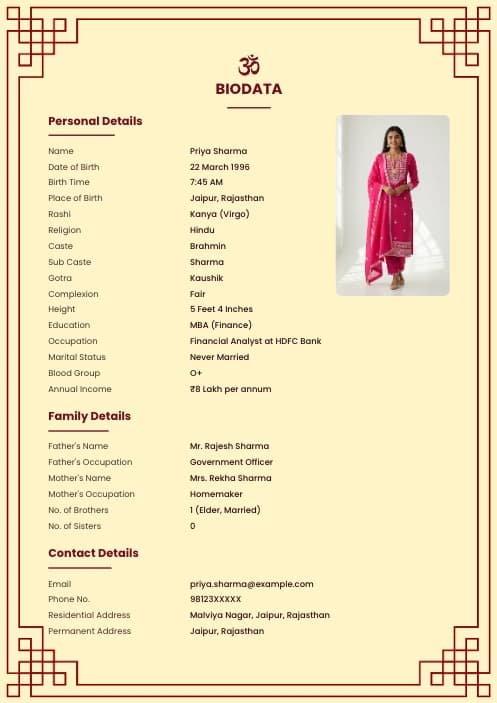
A biodata format is a structured document used in India for marriage proposals. It presents personal, educational, professional, and family details in a clear and organized layout so the other family can get to know you quickly. Unlike a resume, a marriage biodata format focuses on personal values, family background, horoscope details, and partner expectations — not just career achievements.
A well-prepared simple biodata format creates a positive first impression and communicates who you are as a person and as a family. It is typically shared via WhatsApp, email, or print in PDF or Word format.
Quick Fact: The word "biodata" comes from "biographical data." In the Indian marriage context, it is also called a matrimonial profile, shadi ka biodata, lagna patrika, or simply a marriage profile.
Standard Biodata Format – Section by Section
A complete biodata format for marriage should cover the following sections. Each section serves a specific purpose in giving the other family a complete picture.
Personal Details
This is the first and most important section. Include: full name, date of birth, time of birth (for horoscope), place of birth, height, complexion, and blood group. Keep this section factual and honest — families verify these details early in the process.
Religious & Community Details
Include religion, caste, sub-caste, gotra, and manglik status (for Hindu format). For Muslim biodata, include sect (Sunni/Shia), practice of namaz, etc. This section helps families identify compatibility within their community.
Horoscope / Kundli Details
For Hindu marriages, this section is often mandatory. Include rashi (moon sign), nakshatra, and whether kundli matching is required or flexible. If you have a prepared kundli, mention that it can be shared separately.
Education Details
List highest qualification, university/college name, year of completion, and specialization. Mention any professional certifications, diplomas, or achievements. Education is a major compatibility factor in most modern Indian families.
Occupation & Income
Include current job title, employer/company name, city of work, and approximate annual income or CTC. For self-employed or business owners, mention the nature of business and annual turnover range. For NRI candidates, include country, visa type, and visit frequency.
Family Background
This section carries significant weight. Include father's name and occupation, mother's name and occupation, number of siblings and their marital status and professions. Mention family type (nuclear/joint), native place, and any family values you want to highlight.
Partner Preferences
Clearly state what you are looking for in a partner — age range, educational background, working/non-working preference, willingness to relocate, and any other expectations. Being clear here saves time for both families.
Contact Information
Include a phone number (WhatsApp preferred), email address, and current city of residence. Some families include a postal address, though this is increasingly optional. This section is what enables families to initiate contact.
Sample Biodata Format – What to Write
Many people are unsure what exact text to write in a biodata format for marriage. Here is a sample that you can use as a reference:
Personal Details
Name: Priya Sharma | Date of Birth: 12 March 1997 | Age: 28 Years
Height: 5ft 4in | Complexion: Fair | Blood Group: B+
Place of Birth: Jaipur, Rajasthan | Time of Birth: 07:30 AM
Community
Religion: Hindu | Caste: Brahmin | Sub-caste: Saraswat | Gotra: Kashyap
Rashi: Taurus | Nakshatra: Rohini | Manglik: No
Education & Career
Qualification: B.Tech (Computer Science), VIT University 2019
Occupation: Software Engineer, Infosys, Pune | CTC: ₹8.5 LPA
Family Details
Father: Mr. Ramesh Sharma – Govt. Employee (Retired)
Mother: Mrs. Sunita Sharma – Homemaker
Brother: 1 (Married) | Sister: 1 (Unmarried, working)
Family Type: Nuclear | Native: Jaipur
Partner Preferences
Age: 28–33 years | Education: Graduate & above | Profession: Any
Caste: Open to same community | Location: Flexible
Contact
Phone: +91 98765 XXXXX (WhatsApp preferred) | Email: priya@email.com
* This is a sample for reference only. Use our online maker to create your personalized biodata with a professional design.
Biodata Format PDF vs Word – Which Should You Use?
Both formats have their uses. Here is a quick comparison to help you decide which biodata format download is right for you:
PDF Format
Recommended- Maintains design exactly as created
- Works on all devices and operating systems
- Best for WhatsApp & email sharing
- Professional look for printing
- Cannot be edited after download
Word Format
- Fully editable in MS Word or Google Docs
- Easy to update as details change
- Can be converted to PDF anytime
- Layout may shift on different systems
- Good if you want to make frequent edits
Our biodata maker lets you download in both formats from the same template. Most families prefer PDF biodata format for sharing and printing.
Tips for Writing a Strong Marriage Biodata
Beyond the format itself, how you present information inside a biodata format for marriage matters a great deal. These tips help your biodata stand out for the right reasons:
Be factual and specific
Vague descriptions like 'good income' are less effective than '₹12 LPA at XYZ Company'. Specific details build trust and help families make faster decisions.
Use a clear, recent photo
A professional-looking portrait photo (plain background, good lighting, formal or semi-formal attire) significantly improves response rates from prospective families.
Keep it to one page
The most effective biodata formats are concise and easy to scan. Include only essential information — families do not want to read a lengthy document at this stage.
Match template to your community
A traditional Hindu family may respond better to a design with cultural elements, while a modern urban professional may prefer a clean, minimal layout. Choose accordingly.
Update regularly
Your biodata should reflect current information. If your job, income, or family situation changes, update and re-download. Our online maker makes this quick and free.
Get family to review it
Before sharing widely, have parents or a trusted family member review the biodata. They often catch missing details or suggest improvements from experience.
Biodata Format by Community & Religion
Different communities in India have slightly different expectations for a marriage biodata format. Here is a quick overview:
Hindu Biodata Format
- Horoscope section (rashi, nakshatra, gotra, manglik)
- Caste and sub-caste clearly mentioned
- Religious practices and values
- Family deity (kuldevi) sometimes included
Muslim Biodata Format
- Sect (Sunni/Shia) and religious observance
- Namaz (prayer) practice mentioned
- Family's Islamic values highlighted
- No horoscope section required
Christian Biodata Format
- Church denomination and attendance
- Baptism status
- Family's Christian background
- Similar structure to general format
Sikh Biodata Format
- Amritdhari status mentioned
- Gurdwara attendance
- Turban preference (for boys)
- Gotra and family background
Jain Biodata Format
- Digambar or Shvetambar sect
- Vegetarian/Jain dietary practices
- Business or professional background
- Community and family values
South Indian Format
- Star (nakshatra) is primary matching criterion
- Rashi, lagnam details required
- Native place and mothertongue
- Community sub-divisions (e.g., Iyer, Iyengar for Tamil Brahmin)
All these community-specific biodata formats are available in our template collection. Browse to find the design that matches your cultural background.
Frequently Asked Questions – Biodata Format
What is the correct biodata format for marriage?
There is no single 'correct' format — but a standard marriage biodata format should include: personal details, community/religious information, education, occupation, family background, partner expectations, and contact details. The design and emphasis may vary by community.
Is a simple biodata format better or a premium design?
A simple biodata format is perfect for most situations — it's clean, loads quickly on WhatsApp, and presents information clearly. Premium designs are worth it when you want to make a strong visual impression or your community values elaborate presentation.
How do I download a biodata format PDF for free?
Use our online biodata maker — fill in your details, choose a free template, and download as PDF instantly. No login required. Free templates are always available; premium designs (₹40–₹80) offer more customization.
Can I create a biodata format in Hindi or other Indian languages?
Yes. Our maker supports multiple Indian languages including Hindi, Marathi, Gujarati, Tamil, Telugu, Malayalam, Kannada, Punjabi, Bengali, and more. Simply select your language when filling the form.
What photo should I use in my biodata format?
Use a recent, clear portrait photo with a plain (preferably white or light) background. Formal or semi-formal attire is ideal. Avoid selfies, group photos, or sunglassed photos — these look unprofessional.
How long should a marriage biodata be?
Ideally, a marriage biodata format should fit on one A4 page. Two pages at most if you are including extensive family details. Keep it scannable — families review many biodata and a concise, well-organized format stands out.
Ready to Create Your Biodata?
Use our free online maker to create a professional marriage biodata format in minutes. Click below, fill in your details, and download as PDF — no sign-up needed.