Free Biodata for Marriage — Create Bio Data Online in 2 Minutes
184 Biodata Created Today
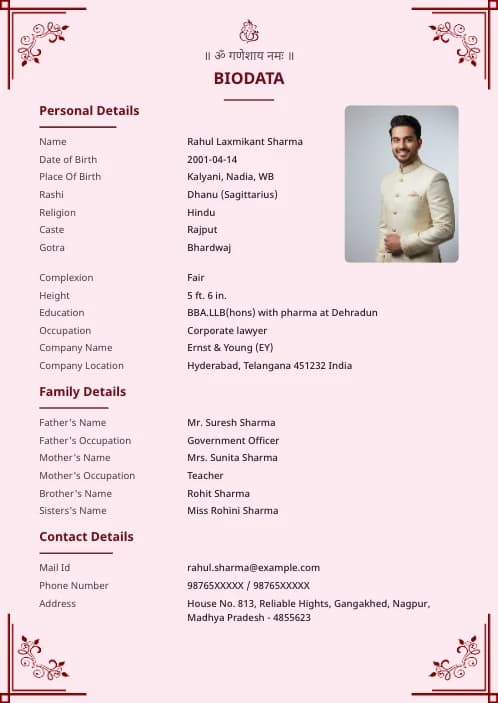
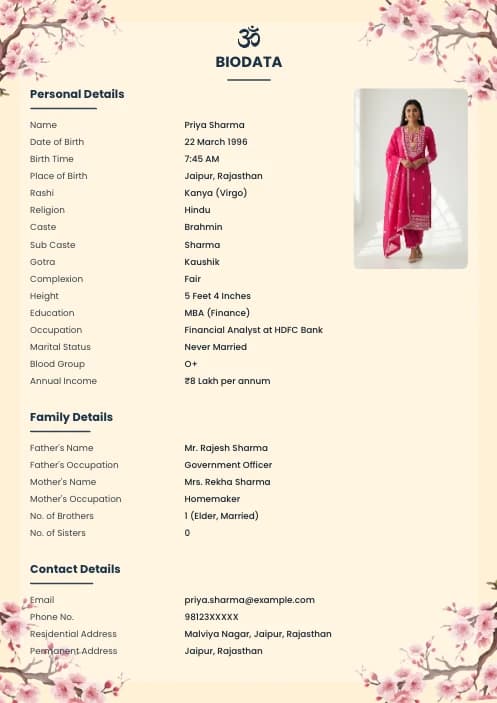
Biodata for Marriage — 50+ Free Templates for Every Community
Hindu, Muslim, Sikh, Christian & more. Click any design to use it.
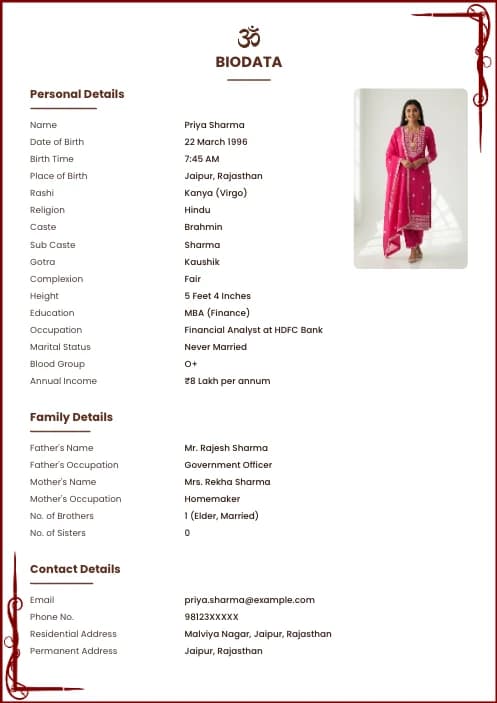
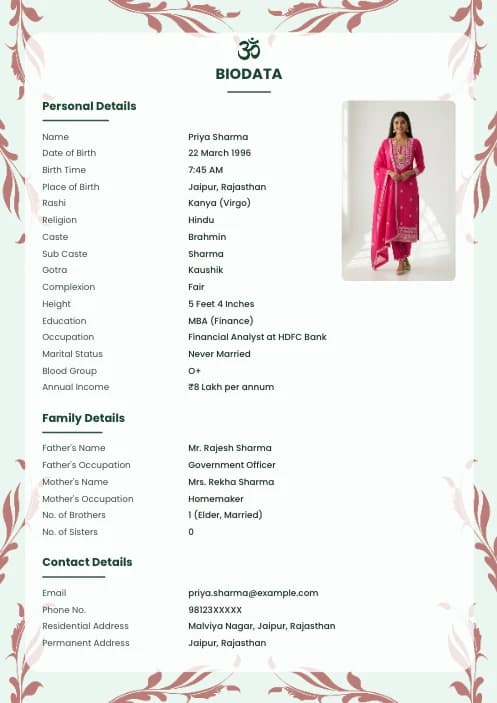
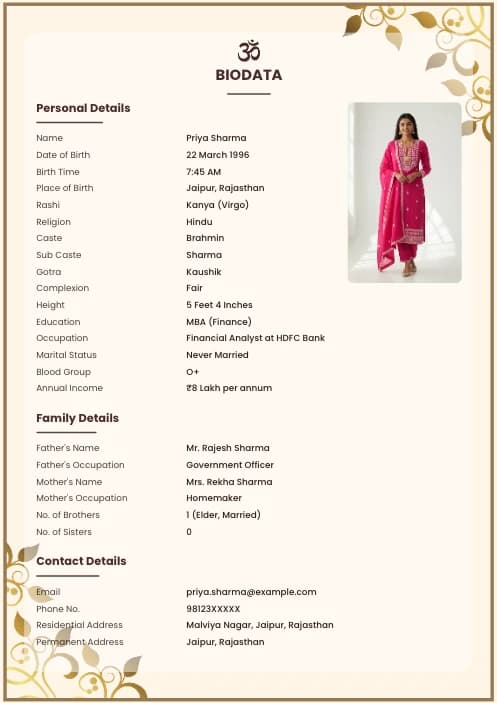
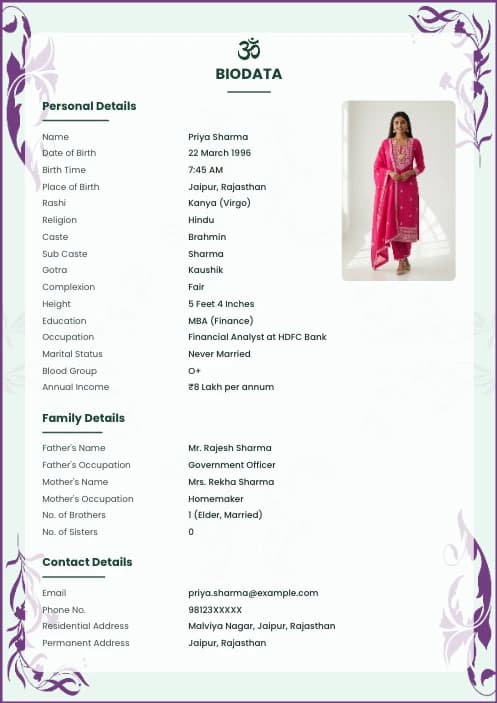
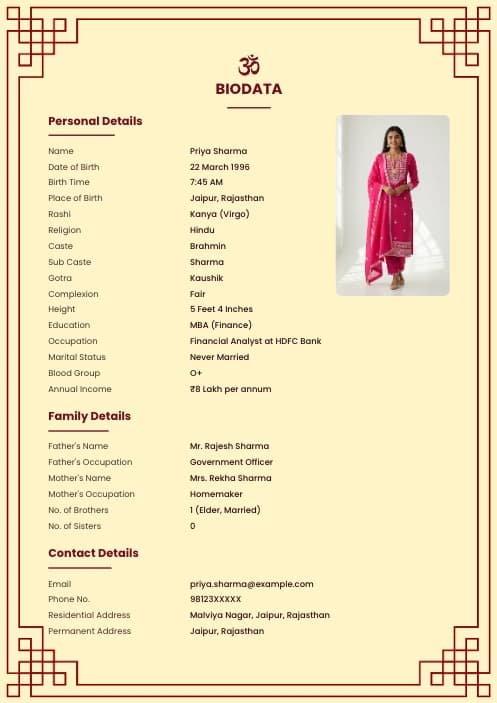
Start Creating Your Marriage Biodata
Online Marriage Biodata Form
Start creating your marriage biodata using our simple and intuitive online form. No design skills required.
Service Disclaimer: This is a document-formatting tool only. We do not offer matchmaking, dating, or introduction services, and we do not match or connect users.
We Respect Your Privacy
No login, no sign-up, no hidden charges. Your details stay on your device not on our servers. Only you control your biodata.
Trusted by families across India who value privacy and speed.
No Login, No Storage
Your personal details never leave your device. No accounts, no data storage, no privacy concerns just instant biodata creation.
2-Minute Download
Faster than ordering coffee. Select template, fill details, download PDF all in 2 minutes on your mobile phone.
Any Indian Language
Hindi, Tamil, Gujarati, Marathi, Telugu, Urdu and more. Templates that respect your cultural traditions and family customs.
Loved by Families
Trusted by parents, brides, grooms and marriage agents across India. Professional quality that makes great first impressions.
How to Create Biodata for Marriage — 3 Simple Steps
No design skills. No login. Ready in under 2 minutes.
Choose Your Template
Pick from 50+ designs for Hindu, Muslim, Sikh, Christian and regional communities. Available in Hindi, Gujarati, Marathi, Tamil, Telugu, Urdu & English.
30 secFill Your Details
Enter personal, family, education and career info. Add a photo, horoscope section, or partner preferences — all optional, fully customisable.
1 minDownload PDF Instantly
Your professional marriage biodata is ready. Download high-quality PDF, share on WhatsApp, or print — no login, no waiting, completely free.
InstantWhy Families Choose Simple Biodata Maker
Free · No login · Download in 2 minutes
Create Biodata Instantly
ReadyMake biodata for marriage and download your professional PDF in just 2 minutes. No waiting, no delays - get your biodata format ready to share with matches and family immediately.
Marriage Biodata in Any Language
LanguagesCreate shadi biodata in Hindi (शादी बायोडाटा), Tamil, Gujarati, Marathi, Telugu, Urdu & more. Choose biodata templates that respect your cultural traditions and family customs.
Free Biodata Maker - No Login
Privacy FirstOur online biodata builder works perfectly on your phone. No sign-up required to create biodata for marriage, no personal data stored. Your privacy is completely protected.
Biodata for Marriage: Free PDF & Word Download
Create a professional biodata for marriage in minutes, free. We have templates for every Indian community, available as PDF or Word (DOC/DOCX). No login, no subscription needed.
Simple Biodata Format
Clean and minimal, with all the sections families expect.
✓ Free Forever
Create FreeBiodata Format in Word
Editable DOC/DOCX — works in Word, Google Docs & WPS.
✓ Free & Premium
Get StartedPremium Templates
Exclusive designs with advanced customisation & photo editing.
From ₹40–₹80
View PremiumBiodata Format in Your Language
Create marriage biodata in Hindi, Gujarati, Marathi, Tamil, Telugu, Kannada, Urdu & more — your family can read it comfortably.
Biodata Format for Boy vs Girl: Key Differences
The basic structure is the same for both, but the emphasis shifts depending on who the biodata is for.
Biodata Format for Boy
- Job & Income: Current employer, designation, and CTC. Financial stability is what most families look at first.
- Property: Own house or flat details are commonly included.
- NRI Status: Country, visa type, and how often he visits India if he's abroad.
- Physical Details: Height and complexion — kept brief, but rarely skipped.
Biodata Format for Girl
- Education & Career: Increasingly important. Most families today look for an educated, working partner.
- Skills & Values: Family values, hobbies, and social interests give a fuller picture of who she is.
- Expectations: Whether she's open to relocating, and her preference on working after marriage.
- Photo: A clear, plain-background photo matters more than most people realise.
5 Mistakes to Avoid in Your Marriage Biodata
These come up again and again in user feedback, and thankfully, all of them are easy to fix.
- ✗Blurry or informal photo
A selfie or cropped group photo makes the wrong first impression. Use a clear portrait with a plain background.
- ✗Leaving sections blank
Missing horoscope, family, or contact details makes the biodata feel incomplete. Families often skip these without a second look.
- ✗Exaggerating details
Inflated income or qualifications come out during discussions and break trust. Accuracy matters more than it seems.
- ✗Wrong template for your community
A very modern minimal design may not sit well with traditional families. Pick something that reflects your values.
- ✗Sharing a compressed file
WhatsApp compresses images and PDFs. Share the original downloaded file, not a screenshot.
Good news: Our templates walk you through every section step by step, so nothing gets missed. You can preview your biodata before downloading to make sure everything looks right.
Ready to Create Your Free Marriage Biodata?
Over 1,00,000 families have downloaded their biodata using our templates. Takes under 2 minutes. Free, no login required.
Biodata for Marriage — Complete Guide
Everything families and candidates need to know — what to include, which format to use, and how to create a professional marriage biodata in minutes.
What is a Biodata for Marriage?
A biodata for marriage is a structured document that introduces you to another family, the way a resume introduces you to an employer. It summarises who you are — your background, education, profession, family, and beliefs — in a clear, readable format that can be shared quickly over WhatsApp, email, or printed for a family gathering.
In Indian culture, this document goes by several names depending on the region and community. In Maharashtra it is called lagna biodata or lagnacha biodata. In Hindi-speaking families it is known as shadi ke liye biodata (शादी के लिए बायोडाटा). Across South India it is often simply referred to as a marriage biodata format. In Muslim communities the term rishta biodata is common. Whatever name your family uses, the document serves the same purpose: to give the other family a complete and honest first impression.
Unlike a professional resume, which focuses on work experience and skills, a marriage biodata covers your personal life holistically — your date and place of birth, religious beliefs, horoscope details, and family members. Most Indian families also include a recent photograph, which helps the other family put a face to the information.
The marriage biodata format has evolved considerably. A generation ago it was handwritten or typed on a single sheet of paper and posted or faxed. Today it is a designed PDF, crafted in minutes using an online tool, downloaded instantly, and shared digitally. The sections it contains, however, have remained largely the same.
Why a Well-Formatted Biodata Document Matters
The question families sometimes ask is: why bother with a biodata at all? Why not simply meet and let conversations do the work? The answer lies in how introductions happen at scale in Indian arranged marriages.
Families are often introduced to several candidates around the same time, through relatives, community groups, and pandits. A well-formatted marriage biodata document presents your information clearly upfront — caste, education, profession, income, family background — so nothing important gets left out or miscommunicated.
There are several practical reasons why a properly formatted biodata matters:
- It creates a professional first impression. A clean, well-designed biodata signals that the candidate and their family are organised and serious. A poorly formatted or incomplete biodata — or worse, none at all — can create doubt before any conversation begins.
- It prevents misunderstandings. When key details like date of birth, education, job title, and family details are written down, there is no ambiguity. Both parties have the same information in front of them, which reduces the chances of miscommunication that often happens through third-party introductions.
- It respects everyone's time. A biodata lets families quickly determine basic compatibility — on religion, caste, location, and income expectations — without a full meeting. This is especially valuable for working professionals and families spread across cities or abroad.
- It is a permanent record. Unlike a conversation, a biodata can be revisited, shared with other family members, and compared. Grandparents who were not present at the initial discussion can read it and give their opinion.
- It is expected. In most Indian communities, arriving at an introduction without a biodata is unusual. Having one ready — especially a well-designed one — shows preparedness and cultural fluency.
A standalone biodata PDF is useful however your family shares introductions. It can be attached to messages, printed for relatives who are not online, or shared through local community networks and temple notice boards that still operate the traditional way.
What to Include in Your Marriage Biodata
A complete biodata format for marriage is usually divided into four sections: spiritual or religious information, personal details, family details, and contact details. Below is a section-by-section guide to filling each one correctly.
1. Spiritual and Religious Information
For Hindu families especially, the spiritual section carries significant weight. Many families will not proceed to a meeting without reviewing the horoscope compatibility first. Even families that do not believe strongly in astrology often include this section because the other party expects it.
- God or Deity Image: Many biodata formats include a small image of the family's preferred deity at the top — Lord Ganesha, Goddess Lakshmi, Lord Venkateshwara, Shiv-Parvati, or a community-specific deity. This gives the biodata a spiritual and cultural identity and is especially important in traditional families.
- Religion: State your religion clearly — Hindu, Muslim, Christian, Jain, Sikh, Buddhist, or Parsi. This is the most basic compatibility filter.
- Caste and Sub-caste: In Indian matrimonial searches, caste still matters to most families regardless of education level or urban location. Common Hindu castes include Brahmin, Kshatriya, Rajput, Maratha, Yadav, Jat, Patel / Patil, Lingayat, Reddy, Naidu, Nair, and hundreds of others. Each caste has sub-castes and regional variants, and families often look for matches within their specific group. Include your caste and sub-caste accurately.
- Gotra: Gotra refers to the patrilineal clan lineage in Hindu tradition. It is important because Hindu customs prohibit marriage within the same gotra (sapinda relationship). Common gotras include Kashyap, Bharadwaj, Vashishtha, Vishvamitra, Gautam, Angirasa, Atri, Garg, Parashar, and many others. Include your gotra so families can check for gotra compatibility early.
- Rashi (Zodiac Sign): Your moon sign or rashi is a key input for Kundali matching. The 12 rashis in Vedic astrology are Mesha (Aries), Vrishabha (Taurus), Mithuna (Gemini), Karka (Cancer), Simha (Leo), Kanya (Virgo), Tula (Libra), Vrischika (Scorpio), Dhanu (Sagittarius), Makara (Capricorn), Kumbha (Aquarius), and Meena (Pisces).
- Nakshatra (Birth Star): Your nakshatra is determined by the position of the moon at the time of your birth. There are 27 nakshatras in Vedic astrology including Ashwini, Bharani, Krittika, Rohini, Mrigashira, Ardra, Punarvasu, Pushya, Ashlesha, Magha, Purva Phalguni, Uttara Phalguni, Hasta, Chitra, Swati, Vishakha, Anuradha, Jyeshtha, Mula, Purva Ashadha, Uttara Ashadha, Shravana, Dhanishtha, Shatabhisha, Purva Bhadrapada, Uttara Bhadrapada, and Revati. Including your nakshatra makes horoscope matching faster and more accurate.
- Manglik Status: Whether the person is Manglik (also called Mangal Dosha or Kuja Dosha) is frequently checked before finalising a match, particularly in North and Central India. Note whether you are Manglik, Non-Manglik, or Anshik (partial) Manglik.
- Time and Place of Birth: These two details are essential for generating and matching a Kundali. Be precise — even an hour's difference in birth time can alter the Kundali significantly.
2. Personal Information
This is the core section that introduces the candidate directly. It should be accurate and specific rather than vague.
- Full Name: Use your complete legal name — first name, middle name (often father's name in Indian convention), and surname. For example: Priya Ramesh Sharma. Avoid nicknames.
- Date of Birth: Write in DD/MM/YYYY format — the standard Indian format. For example: 14/08/1996.
- Age: Some formats include age alongside date of birth for quick reference. Update it whenever you share a new version of the biodata.
- Complexion: This is a sensitive point, but it is still included in most Indian biodata formats because many families ask for it. Options typically range from Very Fair, Fair, Light, Wheatish, to Brown. Be honest — discrepancies discovered during a meeting can break trust.
- Height: State in feet and inches, as is the Indian convention. For example: 5 ft 6 in.
- Blood Group: Include your blood group (A+, A-, B+, B-, AB+, AB-, O+, O-). This is a practical detail that many families now include, especially given the medical awareness around blood group compatibility in pregnancy.
- Education: Write your highest qualification in full — the degree, specialisation, and the name of the institution. For example: B.E. Computer Engineering, University of Pune (2018). If you have a postgraduate degree, include both.
- Occupation / Job: Include your current designation, the name of your employer or organisation, and the city where you work. For example: Software Engineer, Infosys, Bangalore. If you are self-employed, describe your business clearly.
- Annual Income / Salary: This is particularly important in the boy's biodata, though it is increasingly included for women too. Express it as a monthly figure (e.g., ₹85,000 per month) or an annual figure (e.g., ₹10.2 LPA). Accuracy is important — families will ask about this in person and inflated figures create distrust.
- Hobbies and Interests: Include 3–5 genuine hobbies. These give a sense of personality beyond professional credentials and can serve as natural conversation starters in a first meeting. For example: classical music, trekking, cooking, reading.
- Partner Expectations: A brief, respectful description of what you are looking for in a life partner. Keep this realistic and positive. For example: "Looking for an educated, family-oriented partner who is open to living with joint family."
3. Family Information
In Indian marriages, you are not just marrying a person — you are connecting two families. The family section is often the most carefully read part of the biodata by parents.
- Father's Name and Occupation: Include your father's full name and his current or retired profession. For example: Mr. Ramesh Kumar Sharma — Retired Government Officer.
- Mother's Name and Occupation: Include your mother's full name and occupation. For example: Mrs. Sunita Ramesh Sharma — Homemaker. Or: Mrs. Sunita Ramesh Sharma — School Teacher (Retired).
- Brothers: List brothers with their marital status. For example: Rohit Sharma (Married — Software Engineer, Hyderabad). If you have no brothers, it is fine to leave this field blank or write "Not Applicable."
- Sisters: Similarly, list sisters with marital status and occupation if relevant. For example: Pooja Sharma (Unmarried — MBA, working in Mumbai).
- Family Type: State whether your family is Nuclear, Joint, or Extended. This is important context — many families have a preference, particularly when it comes to post-marriage living arrangements.
- Native Place: Your ancestral hometown or village, especially if your current city of residence is different. This is important for community-matching within castes that have regional sub-divisions.
- Relatives and Social Standing: Some biodata formats include the surnames of notable relatives (uncles, maternal family) — particularly in communities where extended family reputation matters. Keep this section brief — 5 to 8 surnames at most.
4. Contact Information
The contact section is short but critical. If the other party is interested, this is how they reach you.
- Mobile Number: Include one or two numbers — ideally the candidate's number and a parent's number. Many families prefer to speak with a parent first. Include the WhatsApp number separately if it is different.
- Email Address: A professional email address adds credibility. Avoid using very casual usernames.
- Residential Address: Your current city and locality (not necessarily the full street address for privacy reasons). For example: Bandra West, Mumbai — 400050.
Types of Marriage Biodata Format
Not all biodata formats are the same. The right format depends on whether the biodata is for a boy or a girl, how traditional the family is, and which community the person belongs to. Below are the main types you will encounter.
Marriage Biodata Format for Boy
The biodata format for boy typically emphasises professional and financial details, since most Indian families — particularly the bride's family — look at the groom's earning capacity and stability first.
Key sections that are given more prominence in a boy's biodata:
- Job and Designation: The current role, company name, and years of experience. For engineers, doctors, or government officers, the employer's brand name often carries its own weight.
- Salary and Income: State the CTC or monthly take-home. Many families in semi-urban and rural areas still specify this directly; urban families may phrase it as a range (e.g., ₹8–10 LPA).
- Property: Whether the family owns a house or flat is increasingly mentioned — especially for grooms whose family expects the couple to live with them.
- NRI Status: If the groom is working or settled abroad, mention the country, visa type (work visa, PR, citizenship), and how often he visits India. This significantly affects the expectations of both families.
- Physical details: Height and complexion are noted briefly but rarely omitted.
For the photo in a boy's biodata, a formal or semi-formal portrait — collared shirt, plain background — works best. Group photos or travel selfies are a poor choice for this purpose.
Marriage Biodata Format for Girl
The biodata format for girl has changed significantly over the past decade. The education and career section is now as important as family background in most urban and semi-urban families. A girl with a postgraduate degree or a stable career in a reputed organisation is seen as a strong match in most communities.
Key sections emphasised in a girl's biodata:
- Education: The degree, institution, and year of graduation. Postgraduate qualifications, professional certifications (CA, MBBS, B.Tech), and reputed universities carry extra weight.
- Occupation: Current employer, designation, and city. Many families now specifically look for a working bride, particularly in urban families.
- Skills and Values: Hobbies, cooking ability (still mentioned in many traditional biodata), and social interests. These give a sense of personality beyond degrees.
- Post-marriage preferences: Whether she is open to relocating, whether she plans to continue working after marriage — these expectations, if stated upfront, save time for everyone.
- Photo: A clear, well-lit portrait matters perhaps even more than in a boy's biodata. A saree or salwar kameez in a plain-background photo is the standard. The photo should look like the person — not a heavily filtered social media version.
Biodata Format With Photo vs Without Photo
Most families today prefer a biodata with a photograph. A photo immediately humanises the document and reduces the awkwardness of the first meeting. If you are comfortable including a photo, it will almost always increase the response rate to your biodata.
If privacy is a concern — which is a valid and common concern, particularly for working women who do not want their photo shared widely across unknown networks — it is perfectly acceptable to share a biodata without a photo for the initial exchange and provide a photo directly to serious inquiries.
Community-Specific Biodata Formats
Different communities have their own conventions for what a biodata should include and how it should be designed:
- Hindu Marriage Biodata: Includes the full horoscope section — rashi, nakshatra, gotra, manglik status, time and place of birth. A deity image at the top is standard. Browse Hindu biodata templates →
- Muslim Marriage Biodata (Rishta Biodata): Focuses on sect (Sunni, Shia, etc.), religious practice, and family piety. Horoscope sections are not included. Browse Muslim biodata templates →
- Christian Marriage Biodata: Denomination (Catholic, Protestant, CSI, etc.) and church affiliation are mentioned. Family background carries significant weight. Browse Christian biodata templates →
- Jain Marriage Biodata: Sect (Digambara or Shvetambara), dietary practices, and business family background are highlighted. Browse Jain biodata templates →
- Sikh Marriage Biodata: Gotra and village of origin are important. Anand Karaj is the wedding ceremony and the biodata may mention whether the family is Amritdhari. Browse Sikh biodata templates →
- Brahmin Marriage Biodata: Veda (Rigveda, Samaveda, etc.), gotra, and sub-caste (Iyer, Iyengar, Saraswat, Gaur, Deshastha, etc.) are specified in detail, since Brahmin sub-caste matching is often as important as the main caste.
- Rajput Marriage Biodata: Clan (Sisodia, Chauhan, Rathore, Tanwar, etc.) and ancestral village are typically included.
- Maratha Marriage Biodata: Kul (clan) and Kulswamini (family deity) are mentioned alongside standard sections. The Marathi language version — lagnacha biodata — is commonly used in Maharashtra.
How to Create a Marriage Biodata Online — Step by Step
Creating a professional marriage biodata online no longer requires a designer, a Word template, or a trip to a printing shop. With Simple Biodata Maker, the process takes under 2 minutes from any phone or computer.
- Choose your template. Browse from 50+ professionally designed templates. There are templates for Hindu, Muslim, Christian, Jain, Sikh, and all regional Indian communities. Pick a design that matches your family's aesthetic — traditional, modern, elegant, or minimal.
- Select your language. Fill in your biodata in Hindi, Marathi, Gujarati, Tamil, Telugu, Kannada, Bengali, Urdu, or English. All field labels and headings switch to your chosen language automatically.
- Fill in your details. Work through the personal, family, and contact sections. Every field has a clear label. Leave any field blank and it simply won't appear in the final biodata — there is no penalty for incomplete fields, only for fields that are left blank when they matter to the other party.
- Add a photo and deity image (optional). Upload a portrait photo and choose from 40+ deity images to place at the top. Both are optional but strongly recommended for Hindu biodata.
- Preview your biodata. See exactly how the final document will look before downloading. Make any last changes to layout, details, or template.
- Download as PDF. Click download to get a high-quality PDF instantly. No login, no payment for free templates, no watermark. The file is optimised for both WhatsApp sharing and printing.
The downloaded PDF is immediately ready to share — on WhatsApp, by email, or printed for a family gathering.
Design Tips for a Better Marriage Biodata
The information in your biodata is what matters most — but the way it looks determines whether someone reads it carefully or skims it quickly. A few simple design principles make a significant difference.
- Match the template to your community's taste. A traditional Rajput family from Rajasthan will likely respond better to a classic, ornate design with a warm colour palette. A Bangalore-based tech professional looking for an urban match will find a clean, minimal template more appropriate. The template is a signal about who you are — choose accordingly.
- Use a clear, well-lit photograph. The photograph is probably the single most impactful element of a marriage biodata after the core details. A blurry, dark, or cropped group photo creates a poor impression. Use a plain background — white, light grey, or a solid colour — and ensure the face is clearly visible. A recent photo (within the last 6 months) is always better.
- Keep the font readable. Decorative or script fonts may look attractive in a design preview but become difficult to read when printed or viewed on a small phone screen. A clean serif or sans-serif font in a readable size is always the right choice.
- Do not try to fit everything on one page. A two-page biodata that is readable and well-spaced is far better than a single-page biodata with tiny text crammed into every corner. Space allows the reader to absorb information comfortably.
- Be consistent with capitalisation and formatting. Mixed caps, inconsistent date formats, or irregular spacing make a biodata look hurriedly prepared. Take 5 minutes to review before downloading.
How to Share Your Marriage Biodata
Once your biodata is downloaded, sharing it correctly is as important as creating it well. A few guidelines:
- Share the original PDF, not a screenshot. WhatsApp and most messaging apps compress images, which makes a screenshot of your biodata blurry and difficult to read. Always share the PDF file directly from your downloads folder. PDF files maintain their quality through WhatsApp file sharing even when compressed.
- WhatsApp sharing: Tap the attachment icon in WhatsApp, select "Document", and choose your biodata PDF. This preserves the original quality. Do not share it as a photo.
- Email: Attach the PDF directly to the email. Keep the email brief and professional — your biodata contains all the detail they need.
- Offline sharing: Print on A4 paper, single-sided, in colour if possible. A colour printout of a well-designed biodata is noticeably more impactful than a black-and-white one, particularly at community events or family gatherings where multiple biodata are being reviewed side by side.
- Update before re-sharing. If your job, income, or any personal detail has changed since you last created your biodata, update it before sharing again. Sending outdated information causes confusion during discussions and can appear careless.
Ready to create yours? Start your free marriage biodata — no login, no signup, download in 2 minutes. Or browse all 50+ templates first.
Your Questions, Answered
Everything you need to know about creating your marriage biodata.
Is creating a biodata really free?
Yes — completely free. You can create and download your marriage biodata with our free templates at no cost. Premium templates (₹40–₹80) are available for exclusive designs, but there are no hidden fees, subscriptions, or watermarks on free downloads.
Is my personal data safe?
Your privacy is our top priority. Biodata creation happens entirely in your browser — nothing is uploaded to our servers. We don't store your personal information, and no login is required. Your data never leaves your device until you download the PDF.
How long does it take to create a biodata?
Most users finish in under 2 minutes. Choose a template, fill in your details, and download — it's that straightforward. No design skills or software needed.
Can I preview before downloading?
Yes. You get a live preview as you fill in your details, so you can see exactly how your biodata looks before downloading. Make any changes until you're happy, then download instantly.
Can I create biodata in Hindi, Marathi, or Gujarati?
Absolutely. We support all major Indian languages — Hindi, Marathi, Gujarati, Tamil, Telugu, Kannada, Punjabi, Bengali, Urdu, and more. Select your language when starting, and the biodata fields and labels appear in your chosen script.
Which biodata format works for Hindu marriage?
Our Hindu templates include dedicated sections for horoscope details — birth time, nakshatra, rashi, and gotra — along with traditional design elements. Muslim templates include sect information and Islamic design patterns. Pick a community-specific template and all the right sections are pre-included.
How do I download my final biodata?
Once you've filled your details and are happy with the preview, click Download. Your biodata is generated as a high-quality PDF, ready to print or share.
Can I share the biodata on WhatsApp?
Yes. The downloaded PDF is optimised for WhatsApp sharing. File size is kept small without compromising print quality, so it looks sharp on any device.
Still have a question?
Marriage Biodata Tips & Guides
Expert articles to help you create the perfect matrimonial profile
Buddhist Marriage Biodata Format — Jay Bhim Style Guide in Marathi & English (2025)
Create an authentic Jay Bhim style Buddhist marriage biodata. Complete guide for Ambedkarite families covering what to include, sample formats in Marathi & English, and free PDF download.
Lagnacha Biodata Format in Marathi: Complete Guide 2025 (लग्नाचा बायोडाटा)
Complete guide to creating the perfect lagnacha biodata in Marathi. Covers gotra, devak, kuldevata, vadhu vs var format, bilingual tips, and free PDF download.
Biodata for WhatsApp: Ready-to-Copy Text Format Templates (2025)
Share your marriage biodata instantly on WhatsApp. Get free, ready-to-copy text format templates for General, Hindu, and Modern minimal profiles.
Marriage Biodata Format in Hindi – शादी का बायोडाटा कैसे बनाएं (2025)
Learn how to make the perfect Shadi ka Biodata in Hindi. Complete guide with sample format, personal details section, and family information in Hindi language.